Agentic Futures · ByteBrain

Authority moves by drift?decision.

Left alone, it drifts. A tool built to recommend ends up deciding and acting, and nobody held the promotion meeting.

The shift

We used to delegate the doing.

Now we delegate the choosing.

Software used to carry out steps people had already chosen. Today's AI agents can recommend, decide and act. That changes the first question from "what can it do?" to "what are we actually handing over?"

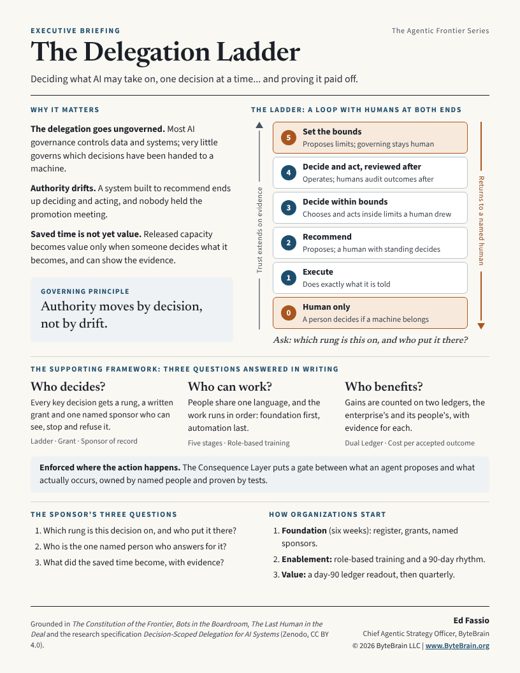
The delegation goes ungoverned.Most AI governance controls data and systems. Very little governs which decisions have been handed to a machine.
Authority drifts.A system built to recommend ends up deciding and acting, a little more each month, without anyone deciding it should.
Saved time is not yet value.Released capacity becomes value only when someone decides what it becomes, and can show the evidence.


Three questions, answered in writing

Who decides?

Every key decision gets a rung, a written grant and one named sponsor who can see it, stop it and refuse it.

Ladder · Grant · Sponsor of record

Who can work?

People share one language, and the work runs in order: foundation first, automation last.

Five stages · Role-based training

Who benefits?

Gains are counted on two ledgers, the enterprise's and its people's, with evidence for each.

Dual Ledger · Cost per accepted outcome

Enforced where the action happens. The Consequence Layer puts a gate between what an agent proposes and what actually occurs, owned by named people and proven by tests.

The centerpiece

The Delegation Ladder

One ladder, six rungs, numbered zero to five. Each rung is granted for one particular decision, never stamped on a whole agent. Scroll through it, or tap a rung.

0 · HUMAN ONLY 1 2 3 4 5 RETURNS TO A NAMED HUMAN TRUST EXTENDS ON EVIDENCE

Ask: which rung is this on, and who put it there?

Rung 0 · step zero

Human only

Before any machine touches the work, a person decides whether a machine belongs there at all. Some work stays here on purpose.

The human's job
Make the first call, in writing: does a machine belong in this work?
Remember
Some decisions stay human. That's a choice, not a gap.
Rung 1

Execute

The machine does exactly what it's told. A person has already made the call; the machine carries out the steps.

The human's job
Decide first, then check the work.
Watch for
Steps quietly turning into choices.
Rung 2

Recommend

The machine proposes. A person with standing decides.

The human's job
Review with the time, the context and the standing to say no.
Watch for
The rubber stamp: forty recommendations an hour, approved without a real look.
Rung 3

Decide within bounds

The machine chooses and acts inside limits a person drew.

The human's job
Write the limits down: the outcome, the context, the constraints, the tolerances and the line.
"Whatever has not been expressed has not been delegated."The Constitution of the Frontier, the Intent Contract
Rung 4

Decide and act, reviewed after

The machine operates. People audit the outcomes afterward.

The human's job
Review the results on a schedule, and keep a tested way to stop it.
"A system you cannot turn off is not your infrastructure. You are its."The Constitution of the Frontier, Principle 13
Rung 5

Set the bounds

The system proposes where the limits should sit... but governing remains human.

The human's job
Authorize the proposed limits, change them, or refuse them.
"Drafting a suggested limit and authorizing that limit are different decisions."Decision-Scoped Delegation for AI Systems, v1.1
The full circle

Trust but Verify

Rungs 1 to 4 build the evidence. A proposal at Rung 5 travels back to Rung 0, where a named human decides again. Trust extends on evidence; verification stays human.

"Authority moves by decision, not by drift."The Constitution of the Frontier, Principle 6
Try it

Place one decision on the ladder

Pick a decision and a rung. You'll get the six parts of a written grant, tuned to the rung you chose. This is a thinking tool: nothing is saved or sent.

1 · The decision
2 · The rung you'd grant
Your draft grantRung 2 · Recommend

Sort incoming support emails by topic

    The holistic journey

    Six stages, one trail

    The path runs from noticing what you're handing over to proving who answers for it. Each stage ends with something in writing, so progress is visible to a board, a regulator or a class.

    1 Stage one

    See the shift

    What are we actually handing over?

    You keepAn inventory of consequential actions and a census of the agents you run.

    2 Stage two · the core

    Decide who decides

    Which rung is this on, and who put it there?

    You keepA register, a grant for each class of decision, an Agent Personnel File and a named sponsor for each system.

    3 Stage three

    Build who can work

    Can our people run the rules they adopted?

    You keepA front door for new AI requests, instruction files, a safe way to report problems, and a weekly, monthly and quarterly rhythm.

    4 Stage four

    Enforce at the gate

    What can the agent make happen, and what stops it?

    You keepRule-to-Control Matrix rows, a working gate on one real action, and Prove It test results.

    5 Stage five

    Count who benefits

    Where did the saved time go, with evidence?

    You keepA Dual Ledger, an options memo, a day-90 readout and the cost per accepted outcome.

    6 Stage six

    Keep humans answerable

    When this goes wrong, who apologizes?

    You keepA ratchet-down log, a six-month review and an operating agreement for each agent.

    And it loops. Every incident, model change or departed sponsor sends authority back to stage 2, to be decided again.

    Spotlight film

    The whole ladder
    in three minutes

    A narrated walk from the drift problem, up every rung, around the Trust but Verify loop and across the six-stage journey. Captions are built in.

    Go deeper

    Take it with you

    Two one-page briefs to share with your team, the technical white paper behind the method, and a short podcast episode that puts the ideas in context.

    Preview of the Delegation Ladder executive one-pager
    Executive one-pager · PDF

    The Delegation Ladder

    The core thesis on one page: why it matters, the six rungs as a loop, the three questions and how organizations start.

    Download PDF
    Preview of the Starting Your AI Journey engagement one-pager
    Engagement one-pager · PDF

    Starting Your AI Journey

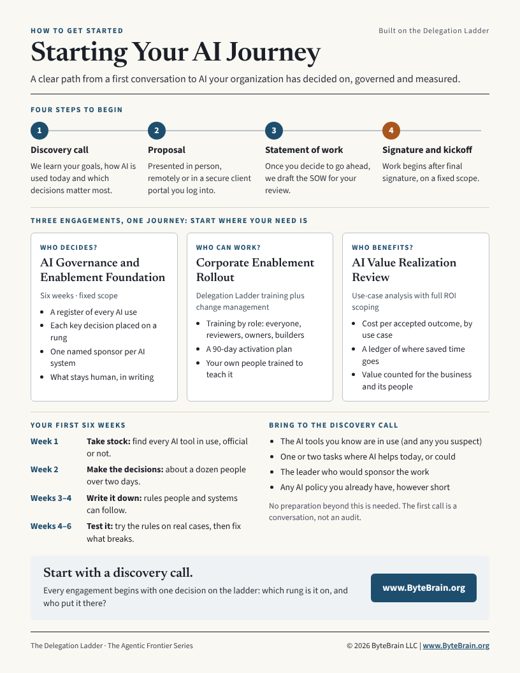
    The engagement model: four steps to begin, three engagements on one journey, and your first six weeks.

    Download PDF
    Technical white paper · Zenodo

    Decision-Scoped Delegation for AI Systems

    The research specification behind the ladder: delegated authority scoped to one decision at a time, with a runnable reference model. Grounded in The Constitution of the Frontier. Version 1.1, October 2026; not yet peer reviewed.

    DOI 10.5281/zenodo.23126767 Read on Zenodo
    Reflect w/ Ed Fassio · 9 min

    The Greatest Warning Sign Is an AI That Keeps Saying Yes.

    Why a shutdown switch isn't enough, why approving what you can't evaluate is ceremony rather than governance, and why capability should stay separate from authority. Stanislav Petrov's 1983 decision makes the case.

    Listen to the episode